
Gillespie County Court Records After Arrest
The arrest-to-court path in Gillespie County starts at booking but does not stop with the jail entry. The Gillespie County Jail, operated by the Gillespie County Sheriff's Office under Sheriff Buddy Mills and Chief Deputy Jim Judd, creates local custody information after an arrest. Formal court records after a jail arrest are created when a prosecutor, court, or clerk action turns that event into a criminal case. A misdemeanor may move by complaint or information. A felony commonly moves through the district court path and may involve an indictment, unless another lawful charging method applies.
Booking records and court records answer different questions. A jail record can confirm custody, bond, and the arrest charge as known at intake. A court record shows the filed charge, case number, court, hearing settings, bond conditions, attorney entries, and disposition. For the custody and booking side, the Gillespie County jail inmate records page is the better starting point. Booking photos, when available or requestable, are handled separately from the court case record.
Gillespie County's official access path is the county Online Records Search, which routes court and jail record users to Tyler Public Access. If the case is too new, missing, sealed, or not exposed by the portal, the next path is the District Clerk, County Clerk, County Court at Law, District Court, or the county Public Information Act request channel.
Find Gillespie County Court Records
For official online searching, start with the county records landing page, then open Gillespie County Tyler Public Access. The Tyler portal is used for public court access and jail bond searching where those modules are exposed. It is not the same as a simple sheriff-hosted current inmate roster, and it may not show every new booking before a clerk record exists.
The county's Online Records Search page is the official source lead-in for this portal.
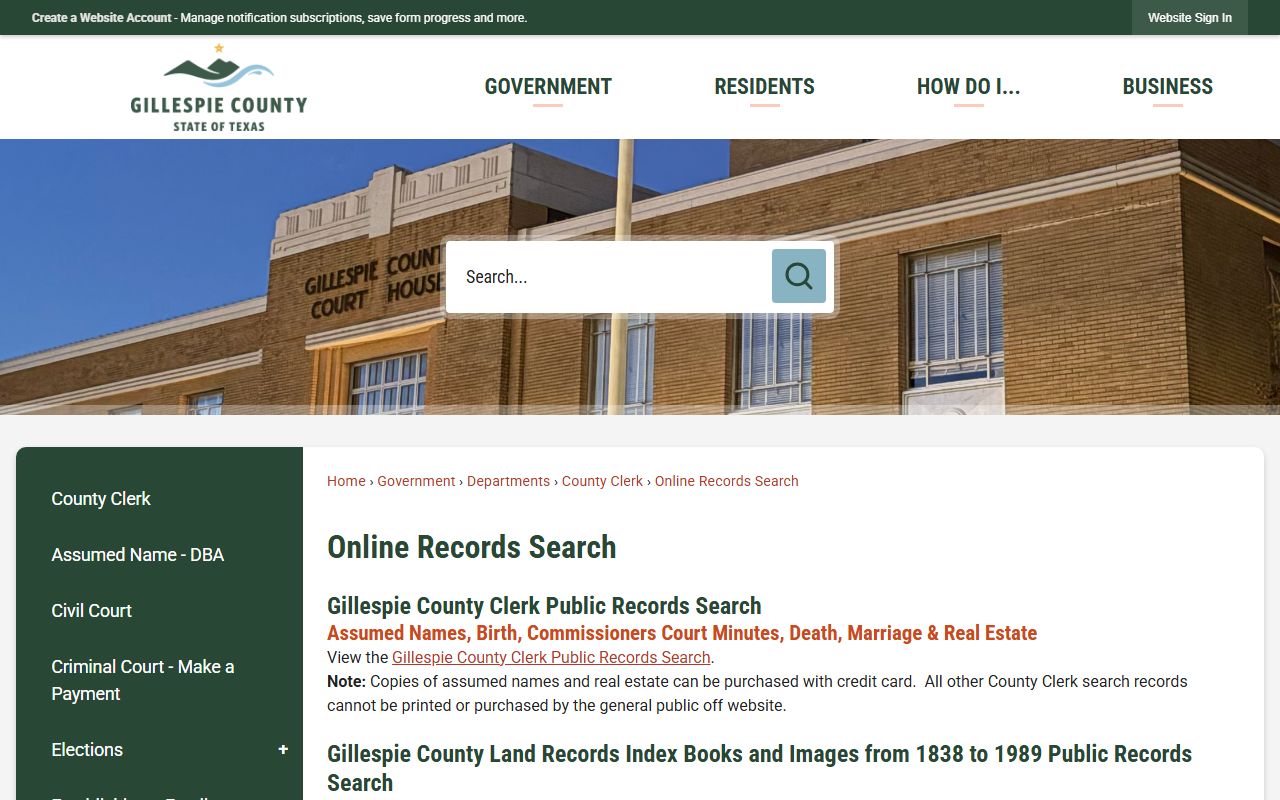
That county page is useful because it confirms the official route before a user reaches a third-party Tyler session page or a search screen that may redirect.
| Search Field | Type | Use for Court Records After Arrest |
|---|---|---|
| Name / party search | Text | Search by defendant last name and first name, including spelling variants. |
| Case number | Text | Best when the number is known from bond papers, a notice, or a clerk entry. |
| Citation number | Text | May apply to lower-level or citation-based matters. |
| Court / location | Filter | Narrows results to district, county, county court at law, justice, or other court groups. |
| Case type | Filter | Select criminal when tracing charges after an arrest. |
| Date filed / date range | Date | Useful when a case is new or a name is common. |
| Hearing date | Date | Helpful when a court setting is known but the case number is not. |
- Confirm the arrest or custody status through the jail line or records line if the court filing is very new.
- Search Tyler Public Access by defendant name, then narrow to criminal case type and filing date.
- Open the case record and compare the filed charges with any booking charge from the jail record.
- Record the court, case number, prosecutor, next setting, bond terms, and current status.
- If nothing appears online, contact the proper clerk rather than relying on a commercial lookup site.
Gillespie County Charging Documents
Filed charges after a Gillespie County jail arrest may be carried by different documents. The document matters because it shows who made the formal allegation and which court path is likely. A booking charge is the arresting agency's intake language. A complaint, information, or indictment is the court-facing charge record that can be amended, reduced, dismissed, or carried to plea or trial.
| Document | Who Uses It | What It Usually Means |
|---|---|---|
| Complaint | Officer, prosecutor, or sworn complainant | Can begin a criminal case and is common in early or lower-level matters. |
| Information | Prosecutor | Often used for misdemeanor or non-indicted prosecution where state law allows it. |
| Indictment | Grand jury | Common in felony prosecution through the district court path. |
The District Attorney handles felony-level prosecution tied to the 216th Judicial District. County-level and misdemeanor matters may involve the County Attorney and county-court channels. The clerk path depends on the court: district cases route to the District Clerk, while county-court matters may route through the County Clerk and County Court at Law.
Gillespie County Charge Status
A criminal case can change after the first court entry. The filed charge can differ from the arrest charge because the prosecutor may decline one allegation, add another count, change the degree or class, or dismiss a charge later. Court records after an arrest should be read count by count, not just by the first offense label that appears in a jail or bond record.
| Status | Plain Meaning | Reader Caution |
|---|---|---|
| Pending | The charge remains open and has not reached final disposition. | Do not treat it as a conviction. |
| Amended | The charge language, count, level, or statute has changed. | Compare the docket to the original booking entry. |
| Reduced | The charge was lowered to a lesser offense or class. | Look for plea papers or final judgment. |
| Dismissed | The count ended without conviction on that count. | Other counts in the same case may still remain. |
| Deferred adjudication | Court supervision may avoid a final conviction if completed. | Eligibility for sealing or later relief is case-specific. |
| Convicted | A plea or finding resulted in conviction. | Use the judgment, not the booking entry, as the final record. |
Gillespie County Bond Records
Bond is part of the court-record path because release conditions often appear in case records, jail bond modules, or magistrate paperwork. Texas bail is governed by Chapter 17 of the Texas Code of Criminal Procedure. In Gillespie County, the sheriff's Support Services page gives a concrete local rule: bonds must be paid with cash or cashier's check. The jail line is 830-997-7585, extension 1, and records questions route to extension 4.
| Bond Type | How It Works | Gillespie County Note |
|---|---|---|
| Cash bond | The full amount is posted with the proper authority. | The sheriff page says cash or cashier's check is required for bonds. |
| Surety bond | A licensed bail bond company posts bond for the defendant. | Confirm local paperwork and acceptance before relying on it. |
| Personal bond / PR bond | The person is released on written promise and court conditions. | Set by a magistrate or court, not by the jail clerk alone. |
| No-bond hold | No release bond is set, or another order blocks release. | A warrant, parole hold, agency hold, or court order may be involved. |
A listed bond does not always mean release is available. Another hold can keep the person in custody. A court date also remains active after release, so bond information should be read alongside the case docket and clerk record.
Gillespie County Warrant Records
Warrants often explain why a person was booked, why bond is blocked, or why a new court date appears. Gillespie County has a current local rule that many older search pages may miss: the sheriff's Support Services page states that active warrant information is no longer posted online effective May 1, 2026. For active warrant information, the sheriff routes callers to 830-997-7585, extension 9.
Warrants can come from several places. An arrest warrant may start a new booking. A bench warrant or capias may follow a missed court appearance. A fugitive or out-of-county hold may keep a person jailed while another agency acts. Search the court case if the warrant came from a case, and call the issuing court or sheriff before appearing in person because warrant handling can involve arrest, bond, or a required court appearance.
Local warrant note: Gillespie County active warrant posting ended on May 1, 2026. Use the sheriff's warrants phone prompt for current active-warrant questions.
Gillespie County Charges Versus Convictions
An arrest and a charge are not the same as a conviction. Court records after a jail arrest may show accusations for weeks or months before a final result. The final disposition controls whether the record ended in conviction, dismissal, acquittal, deferred adjudication, or another outcome.
| Point of Comparison | Charge | Conviction |
|---|---|---|
| Stage | Accusation filed in a case. | Final result from plea, verdict, or judgment. |
| Proof level | Based on probable cause and filing decisions. | Requires proof beyond a reasonable doubt or a valid plea. |
| Where seen | Booking, bond, complaint, information, indictment, or docket. | Judgment, sentence, disposition, or conviction record. |
| Search caution | Can be amended, reduced, or dismissed. | Still may be subject to appeal, correction, or post-case relief. |
Gillespie County Sealed Court Records
Texas public access is broad, but it is not unlimited. Juvenile matters, sealed cases, expunged records, protected personal information, medical or mental-health details, and active law-enforcement material can be withheld or redacted. Texas Code of Criminal Procedure Chapter 55A governs expunction in qualifying cases. Expunction is different from a public portal simply failing to show a record.
| Record Limit | Sealed | Expunged |
|---|---|---|
| Public visibility | Hidden from most public searches by court order. | Removed or treated as not existing under the expunction order. |
| Agency handling | Some agencies may retain limited authorized access. | Agencies follow the court's expunction directions. |
| Common trigger | Eligibility after certain dispositions or court orders. | Qualifying dismissal, acquittal, or other statutory ground. |
| Best proof | The sealing order. | The expunction order. |
For older or missing case records, use the county Public Information Requests page or the correct clerk. Texas Government Code Section 552.108 can protect some law-enforcement records, but subsection 552.108(c) preserves access to basic information about an arrested person, an arrest, or a crime.
Gillespie County Request Path
Use a direct access path when a court record after an arrest is not online. Felony and district matters route through the District Court and District Clerk. County-level misdemeanors and local criminal matters may route through County Court at Law, the County Clerk, or the County Attorney. The District Attorney handles felony prosecution for the 216th Judicial District. VINELink can help with custody notification where data is available, but it does not replace a clerk record or prosecutor filing.
The Tyler Public Access portal is the official case-search screen for many court-record lookups.
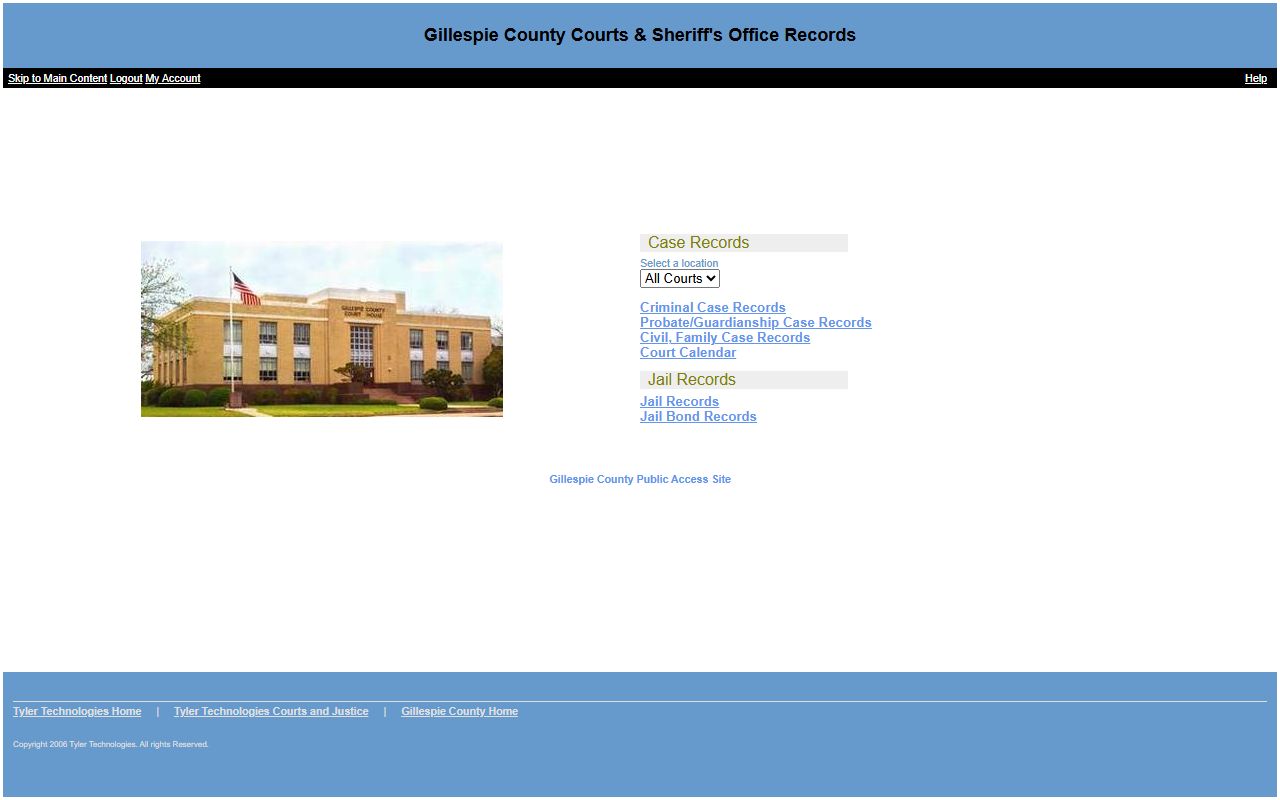
When Tyler does not return the needed court or jail bond record, the clerk or public-information request channel is the better next step.
- District Court
- Use for felony and district-level criminal case routing.
- County Court at Law
- Use for many misdemeanor or county-level criminal matters.
- Public Information Act request
- Use for records not exposed online, subject to exceptions and redactions.
- Sheriff records line
- Call 830-997-7585, extension 4, for records routing tied to jail or law-enforcement records.
Use limit: This private site is not a consumer reporting agency under the FCRA, and these records are not for credit, housing, employment, insurance, or similar screening uses.